The Driver Right-Turn-on Red & Why It Should Be Rethought
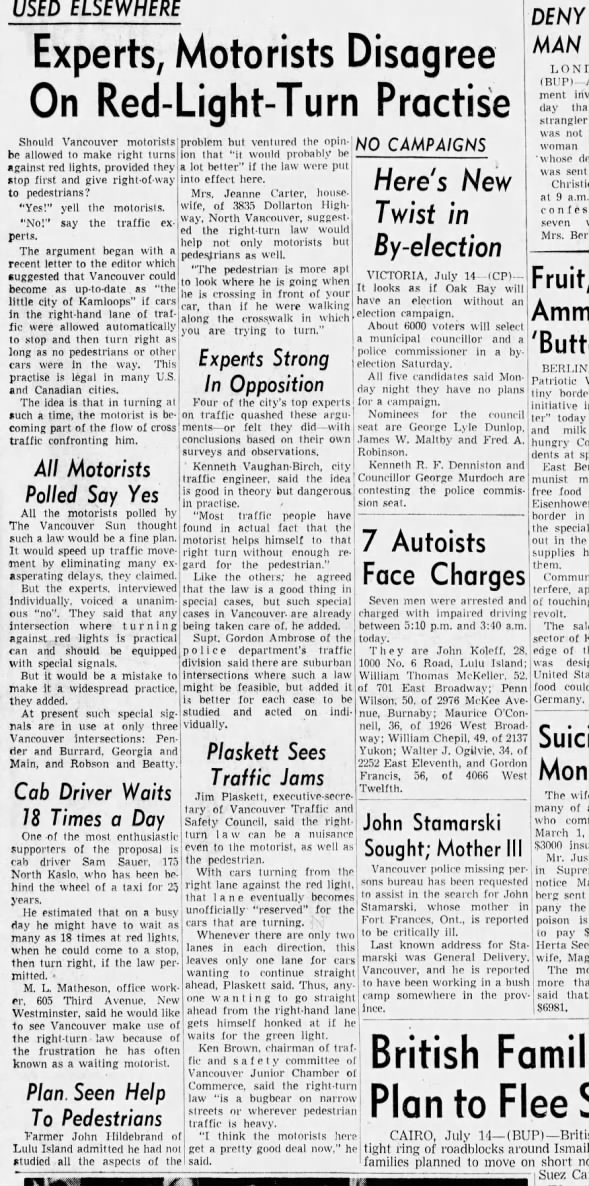
Do you know the history of how vehicle drivers were allowed to turn right at a red light?
And did you know before fifty years ago while some places allowed drivers to turn right at a red light, nearly half of jurisdictions, including most of the eastern United States did not?
It was the 1973 Oil Crisis and the Energy Crisis of 1979 when fuel costs soared that vehicle drivers and governments looked at reducing energy use nationally. It was Alan Voorhees that did work on the “benefits” of the Right Turn on Red System (RTOR). As unlikely as it sounds, allowing a driver to turn right on a red light at an intersection saved between 1 and 4.6 seconds of time. This was seen by the National Energy Department as a significant improvement for energy efficiency, and it was recommended that RTOR be implemented nationally.
Besides the time saving, there was a saving in fuel costs that impacted mainly larger vans and trucks. That is why today many courier companies have their trucks only making right turns to reduce idling, and to keep trucks from waiting in the middle of intersections to complete left turns.
Of course there was also the pesky bit of what happens when vehicles are allowed to turn right on red.
In 2015 Toronto Public Health produced a report showing that the right turn on red driving tactic had resulted in 1,300 pedestrian injuries and deaths from 2008 to 2012. That is 13 percent of all serious injuries and deaths due to vehicle driver crashes. Simply prohibiting the right turn on red would alleviate those injuries and fatalities.
You would think in a country that provides universal health care the concept of Vision Zero, allowing no deaths or serious injury on any roads would be of paramount importance. But the right turn on red permission for drivers has been relatively unchallenged, and the injury and death impact of giving drivers priority is underreported.
Take a look below at two articles from British Columbia published thirty years apart discussing allowing drivers the ability to turn right through red lights. The first article was published in the Vancouver Sun in 1953. The second article by Sydney Harris was published in the Victoria Times Colonist in 1981.
Here we are 40 years later, supposedly championing sidewalk users and cyclists in cities, and still giving vehicle drivers that few seconds of priority with red light turns. At what cost?
In the City of Vancouver there is no major freeway with off ramps through the city and not many places where people can legally travel over 50 kilometers an hour on streets, so any comparison to another major international city with such infrastructure is apples and oranges. But it shows that instead of seriously looking at curb ramp infill and enhancing the walking and rolling environment the City chooses to change the subject.
Metro Vancouver municipalities need to see the enhancement of sidewalks and the walking and rolling environment as vitally important. Curb ramp infill at every corner needs to be done, and should not be delayed for budgetary reasons.
Vehicle driver speed is responsible for one third of all crashes, and implementing slower speeds allows for higher pedestrian survival rates. If 90 percent of pedestrians can survive a vehicle driver crash at 30 km/h and if only 10 percent of pedestrians can survive a vehicle driver crash at 50 km/h, why not implement that survivable speed, as they have done in countless cities in Europe? Why is it in a province that champions universal health care is the ability to implement 30 km/h speeds in municipalities NOT the top priority of the provincial government?
A simple glance in the Coroners’ Service Statistics for 2021 show that despite the pandemic and the fact supposedly less people were driving, 56 pedestrians died in the Province. In comparison in pandemic 2020 there were 35 pedestrians killed.
During the pandemic municipalities encouraged walking and cycling, and in the case of Vancouver implemented Slow Streets as a measure to provide more room for walking and rolling. Given the estimates that 30 to 40 percent of people are still doing some work from home or changing their daily commute, the fact that the number of pedestrians being killed has dramatically risen shows that more needs to be done for pedestrian infrastructure.
In 2022 to date seven pedestrians have died. That is seven people who won’t get home to their families.
In 2021 ten pedestrians died, four while walking or rolling on Vancouver sidewalks.
Figures from March 2019 show that Canada has a rate of 5.8 road deaths per 100,000 people. We can look at the United States with their extensive road networks and a death rate of 12.4 per 100,000.
In British Columbia between 2012 and 2021 55 people a year have died by driver crashes while walking or rolling.
Most of those dead were men at 58 percent of fatalities, and 60 percent of all deaths are people over the age of 50 years. Fraser Health Unit (which includes Delta, Surrey and Burnaby) had 207 people die in this nine year period, while Vancouver Coastal Health had 127 people die. In terms of cities, Vancouver had the highest number of deaths at 87, with Surrey the second highest at 77 lives lost.
While it is now proven that walking and mobility are vital for sociability, engagement, and continued physical and mental health, the City of Vancouver has ignored this most important part of micromobility.
One more example where sidewalk users, undoubtedly the most sustainable mode of transportation are relegated to being second class citizens to electric vehicles. Where is the equity?
The City of Vancouver’s own numbers show why the walking environment needs to be enhanced now: 45 percent of pedestrian fatalities are seniors, and 50 percent of all pedestrian fatalities and serious injuries happen at night. Half of all the vehicle driver crashes in the city that are fatal or life changing injuries involve pedestrians and cyclists. And most of those vehicle driver crashes occur in Vancouver’s low light and rainy winters, meaning that walking infrastructure and lighting should be enhanced and posted vehicle driver speed decreased.
In a province where nearly 80 percent of all driver crashes with pedestrians occur at intersections it just makes sense to improve the walking and rolling infrastructure, slow vehicle driver traffic down, and save people from serious injury and avoidable death in municipalities.
Why is wellbeing and mobility of residents at this micromobility and sustainable level not a priority?
WHO NEEDS A SCRAMBLE? LETS TALK LEADING PEDESTRIAN INTERVALS!
“Pedestrian scramble” is a completely inelegant term for temporarily stopping driver traffic in all directions. Pedestrians are then allowed to cross in four directions in intersectional crosswalks as well as diagonally, for a total of six directions instead of the two directions pedestrians at intersections are so very used to.
The actual name “scramble” sounds like chaos, and it has been called a pedestrian crisscross or diagonal intersection in other places. But that “scramble” name suggests that even when we talk about equity for street users, when it happens for pedestrians they had better move quickly. Despite the name, research at Transport for London has suggested the installation of a diagonal crossing can reduce pedestrian casualties by 38 percent.
The photo above is from Seoul Korea where the scramble intersections have been installed in busy business areas. I am familiar with the scramble intersections in Seoul and they work well. The one requirement though is that there must be large sidewalks and well built walking infrastructure to handle the increased capacity of people that will be using these crosswalks in all six directions.
Some traffic engineers perceive the pedestrian scramble as inefficient as it stops driver traffic in all directions. But that’s a good thing, in that it allows drivers to make left or right turns through the crossing without being blocked by walkers. In Vancouver most pedestrians are hit in intersections during those left and right turn driver vehicle movements.
Vancouver actually was one of the first cities in the world to have pedestrian scamble intersections in the 1950’s. At that time they were called “diagonal” intersections and were placed at Georgia and Granville Streets, Hastings and Granville and Pender and Beatty Streets in 1953. There was also a pedestrian scramble installed in 1965 at the “T” intersection of Columbia and Church Streets in New Westminster.
There is a great story in the Vancouver Sun from December 2nd 1953 when Vancouver Traffic Superintendent Gordon Ambrose decided to treat pedestrians like car drivers at these intersections. In one day with twenty “point men” in a “flying squad” 107 tickets were issued to walkers. These were all court summons for walking not according to the “walk” signal, or on a “wait signal” or getting caught crossing the diagonal intersections when the signal for walking changed.
The use of a pedestrian scramble in high pedestrian traffic areas was mentioned in the 2012 2040 Transportation Report prepared by the City of Vancouver, but turfed because of concerns of crossing for sight impaired individuals.
Here is a video from the City of Surrey which has installed many Leading Pedestrian Intervals as part of their Vision Zero Work with Shabnem Afzal. Ms. Afzal is now the Director of Road Safety Policy and Programs at ICBC, the Insurance Corporation of British Columbia.
images Yonhapnews, Vancouver Archives City of Vancouver
Taking Back the Main Street-The Carson City Story
Carson City Nevada has achieved a remarkable initiative with their main street. This is an unheralded story of how a small city went about reclaiming their historic downtown back from thoroughfare highway use to more pedestrian friendly sidewalks, bike lanes, and slower vehicular flows to bring back walking and cycling locals.
Carson City Nevada is 30 miles south of Reno with a population of 58,993 (2021) and is also the state capitol of Nevada. The downtown contained a lot of important heritage buildings as well as the landscaped grounds for the state capitol, but crossing the main road was dangerous.
Four lanes of vehicle drivers went through Carson Street at speed, and pedestrians were hurt and killed trying to cross the street. At one point the City installed fence barriers along the narrow sidewalk to try to separate pedestrians from vehicles, which did not reduce the crashes and serious injuries. It did not make for an inviting experience on this main commercial street.
With the use of a .08 per cent local sales tax, the City was able to issue bonds to pay for a revamping of their downtown corridor. Utilities were replaced under the road surface, and the street made more walkable and visually interesting by the use of new wide non glare sidewalks, plantings, dropped curbs, pedestrian activated crossings, bike lanes, and attention to detail in textures and materials. That four lane highway was throttled down to one lane in each direction, with a bike lane on either side of the street.
First opened in the Fall of 2016, you can continually visit Carson City (and yes, it is called Carson Street) to see how the street is functioning, and whether the improvements are a success.
The late Mayor Bob Crowell noted that there had been no pedestrian accidents on the street since the new street treatment had been installed. The new street is designed to maintain cars travelling at the posted speed and no faster. There are quick button activation pedestrian crossings throughout the downtown. The design and development of a plaza on a previously opened street has a stage and a kid friendly splash pad, and has small local businesses and outside seating areas for people to linger.
But most importantly, “early adapter” businesses that focus on all segments of the local population have opened, most notably “Scoups Ice Cream and Soup Barwith engaging staff, a plethora of ice cream flavours, and a ready-made place for kids of all ages to hangout and reflect in the adjoining plaza. As several teenagers admitted, there was no reason to come to the main street of Carson City before, as there was nothing of interest. Now with an ice cream and soup bar and open seating outside the store, teenagers feel comfortable and have a sense of belonging in the plaza as do seniors and families.
That is what successful placemaking is all about.
It is no surprise that many locals now are using the downtown Carson Street in a different way, as a place to walk to and to linger. As well new eateries have opened, including The Great Basin Brewing Company which is always busy and attracts hungry visitors from Reno.
Carson City now has a “there there” in the downtown, and is experiencing a renewed interest in its downtown commercial area. The city has a strong arts focus and now has a downtown that is accessible and attractive to pedestrian and bicycle users. Buildings along Carson Street are being renovated, and a new mixed use building with rental apartments on the top floor is being built on a sidestreet. Carson City’s decision to throttle four lanes of through traffic and enhance walking and cycling facilities has enhanced local shopping by bike and by foot is already reaping returns.
images: CarsonNow, sandyjames
December 15, 2022
Brutalism or Brutalist design came out in the mid 20th century as a blocky concrete style with lots and lots of concrete. Everything was overscale, and usually in cold looking geometric patterns. Buildings designed in this style did not have much to offer on the ground plane, which was normally just as desolate an area as the facade of these buildings.
A good Vancouver example is the medical/dental building at 805 Broadway designed by architect Vlad Plavsic. It has great views from the upper floors. And a whole lot of concrete on the interior and the exterior.
There is another name for the fostering of exterior environments in cities that are just not that welcoming to people, and try to minimize opportunities for people to sit, sleep, or stay around. That moniker is “hostile architecture” and we have all seen it-from rounded corners on buildings to discourage people urinating, to benches that are designed for one person to sit on.
Chicago based artist Sarah Ross created “archisuits” over 15 years ago to address the hostile design of public spaces and buildings, and her work is still elemental post pandemic.
As described by Grace Ebert in Colossal, “Ross’s four leisurewear pieces bulge with supports that perfectly fit into the negative space of benches, fences, and building facades. The designs draw a contrast between the soft, bendable wearables and the cold, rigid architecture, which the artist describes as “an arm of the law, a form that uses the built environment to police and control raced, classed, and gendered bodies.”
While we are still struggling to urge the Provincial government to allow municipalities to declare areas of their towns as 30 km/h zones without the costly signage and legalities, the City of Edinburgh continues to show why we need to implement slower driver road speeds.
The adoption of the lower driver road speeds was part of the City of Edinburgh’s commitment to Vision Zero, a strategy to stop all traffic fatalities and injuries while enhancing safe, healthy equitable mobility.
Driver vehicle crashes were reduced by thirty percent in the first three years of the implementation of the 20 mile per hour speed limits, with a coinciding 31 percent drop in death and serious injury. The lower driver road speeds meant that more people bicycled more often.
Nitrogen Oxide emissions also decreased, a key national policy goal of the British government. But the absolutely best part of this evaluation is the analysis that the lower driver speed limits have saved 38.6 million pounds in three years.
That’s the equivalent of nearly 60 million Canadian dollars.
The study also noted that the monetary cost of crashes and deaths would exceed the cost of any intervention to reduce speed, making the overall cost and benefits favourable.
The YouTube video below describes the implementation of the 20 mph speed limits in Belfast and in Edinburgh.
images:Edinburghlive;gov.uk
Better Breathing in Cities & The Miracle of Street Trees
It was over ten years ago that a study called “Sustaining America’s Urban Trees and Forests worked out that one single immature street tree had the same cooling impact as five air conditioners in separate rooms operating twenty hours a day. Simply increasing street trees may bring down summer heat significantly in cities.
Increasing tree canopy in cities not only fights poor air quality and heat islands, trees can reduce the hourly ozone by 15 percent, sulfur dioxide by 14 percent and particulate matter by 13 percent.
Data shows that one healthy tree can remove 300 pounds of carbon dioxide from the air annually. Trees in the United States are estimated to remove 784,000 tons of carbon dioxide annually, a 3.8 billion dollar equivalent value.
Steve Mouzon’s post in CNU.org of two years ago shows that “evapotranspiration” from trees cool heat by 2 to 9 degrees. So how do you cost the value of a street tree? Dan Burden estimates the lifetime benefits of a single street tree as $90,000, and a street that is full of street trees raises the value of the adjacent housing by $22,000 a unit.
There is also some quirky weirdness: there is less crime on streets that are lined with trees. But think of it: the more street trees, the more walkable and accessible and cared for, meaning there are more eyes on the street as well as more foot traffic.
Add in one more benefit for Metro Vancouver: every street tree absorbs one inch of stormwater, so installing and watering street trees pays off as part of stormwater infrastructure.
Here’s a YouTube video from the City Beautiful channel where a Sacramento commentator illustrates why street trees change livability and community.
imageoftrees:TonyValente
After over a year saying they were going to do this, Vancouver Park Board is finally doing what the City of Vancouver should be doing. That is setting up accessible public toilets in “underserved areas” according to the Parks Washroom Strategy. Of course, in Vancouver underserved areas means just about anywhere that is not in a park.
and why it is so special: as outlined in CityLab the design process was unique in that Portland looked at other municipalities’ public toilets and realized that the privacy of them allowed for “nefarious” activities to occur in them.
“We really looked at Seattle as what not to do,” says Anna DiBenedetto, a staff assistant to city commissioner Randy Leonard, the spiritual godfather of the Portland Loo. “We think it was the design that was the fatal flaw. Trying to be comfortable and private makes people feel more empowered to do the illegal activities that people do in public toilets.”
Portland had a “loo squad” 15 years ago and the first Portland loo was installed in 2008 in the Old Town-Chinatown area. It is still there, still functioning. The secret to the success of the Portland loo design is as follows:
-no running water, just a spout on the exterior that pours cold water;-no mirror, as mirrors get vandalized;
-openings at the top and bottom of the Portland loo so that it is not completely private, ensuring that pedestrians and police know if someone is in there.
Add in a graffiti resistant finish and stainless steel walls and doors and the Portland loo is complete. The cost for the first washroom was $140,000 USD, but is now about $90,000. Maintenance is pegged at $1,000 per month per location.
You can take a look at Christine Hagemoen’s excellent article in Scout Magazine where she outlines the history of public washrooms in Vancouver. Ms. Hagemoen also documents what happened during the first part of the pandemic when “ most of us hunkered down in the safety of our Covid-bunkers and obsessed about toilet paper, homeless residents of Vancouver were left scrambling to find an open toilet.”
The first year of the pandemic showed how poorly we deal with equity for homeless people: public washrooms and libraries were closed. These are two places (besides parks) where everyone is welcome no matter who they are.
Paola Lorrigio in The Star bluntly pointed out that the dearth of public washrooms, once a barrier to the homeless, poor, racialized and disabled is now a barrier to everyone. The pandemic also brought out the need for public washrooms to encourage people to get outside, bike, use sidewalks and exercise, when those were the few things open to everyone.
Here’s a video from over ten years ago of the “first flush” of the Portland Loo when it was installed in Portland Oregon. That loo is still there.
Vision Zero refers to zero road deaths and no serious injuries on roads, with the philosophy that every life matters. Applied in Sweden since 1997 the core belief is that “Life and health can never be exchanged for other benefits within the society”. This approach differs from the standard cost benefit approach, where a dollar value is based upon life, and that value is used to decide the cost of road networks and calculate the cost of risk.
We see examples of this all the time and are now inured to these avoidable fatalities as the opportunity cost of driving a vehicle.
There has been ten pedestrians killed so far in Vancouver, one pedestrian a month. One was a woman crossing at Beach Avenue and Broughton Street at 8:00 p.m. (it was still light) on July 27. She was killed by a white SUV. A cyclist also lost his life in Vancouver biking on Pacific at Hornby in July.
It is no surprise that we as a society forgive these fatalities as an unpleasant side effect of the freedom to roam the road in a vehicle. And no surprise that driving over Ms. Lutgens is seen as an offence under the Motor Vehicle Act and not a criminal offence, as there was no proof of criminal intent.
Ms. Lutgens with one of her five children, daughter Ruth
As Keith Fraser writes in the Vancouver Sun, “the court held that there was no evidence of a wanton and reckless disregard for the rules of the road prior to the intersection, and drugs and alcohol were not believed to be involved. Speed did not appear to be a significant factor.”
There are three things that contribute to road fatalities: driver speed, driver intoxication, and driver inattention. The driver was fined for “driving without due care and attention”, given an $1,800 fine, with a one year ban on driving and eighteen months of probation. In court the driver apparently was upset about the driving prohibition as it inhibited taking her children to private school.
Ms. Lutgens, a mother of five children is not alive to give her version of the story, but dash cam footage filmed her final moments. One of Ms. Lutgen’s daughters said in her victim impact statement that the driver:
There are cliffs in terms of the recognition of the collateral damage done to families by these crashes, and the loss of talent and treasure to society in these unnecessary deaths.
This year Parachute Canada has commenced the discussion in a national awareness campaign based on Vision Zero principles that calls on Canadians to #ShareSafeRoads.
Parachute Canada is a national charity dedicated to injury prevention and they have produced a series of quick 30 second videos getting the “driver”, “pedestrian”, “cyclist” and even the “scooter” to sit down and talk to a therapist. We need to commence and continue this dialogue.
We’ve included the English and French version for you to view below.
Image: RuthLutgens,VancouverSun
January 18, 2022
Can You Sue The City Over Snow? Supreme Court and BC Court of Appeals Plow Through the Issues
Two recent court decisions inform how cities will be handling snow removal on sidewalks.
In a ruling that came down in October the Supreme Court of Canada ordered a new trial for Taryn Joy Marchi who hurt her leg climbing over a snowbank in Nelson B.C.
Ms. Marchi had traversed over snow from angled city parking on the street to a city sidewalk. There was no way to access the sidewalk except through a snowbank. Ms. Marchi successfully argued that providing an access in snow from the city parking lot to the sidewalk was not a “core policy decision” but was an “operational decision” taken by the City of Nelson. You can read more about this case here.
This of course has ramifications for other Canadian municipalities. The Supreme Court found that angled parking spaces would not have been cleared if it was not intended for residents to use them, and had a pathway in the snow been cleared in a path from the parking to the sidewalk Ms. Marchi would not have injured her leg. A new trial has been ordered.
Another trial again in British Columbia examined whether residents are liable for clearing the snow in front of their houses. As Jason Proctor notes in this CBC report, Canadians have been suing each other for decades about sidewalk snow removal in front of their houses and slips and falls.
In 2017 Darwin Der slipped and fell on black ice on the sidewalk in Burnaby. His case went to the B.C. Court of Appeal with a lawsuit against the couple who owned the adjacent house, arguing that the property owners owed a “general duty of care to remove snow and ice from their section of the sidewalk.”
The court of appeal judges disagreed, saying those residential property owners had shovelled the sidewalk the previous day and had salted it that day. They had done their civic duty and that “The snow and ice accumulating on public sidewalks and the potholes on the street in front of the house are the legal responsibility of the municipality, not the adjacent property owner.”
So at this point all eyes are back on those municipalities.
The new trial in Ms. Marchi’s case will establish whether it is policy or an operational decision when Nelson plows the on street parking out, but forgets to provide a pathway through the snow onto the sidewalk; and as it stands, if you do the basic shovelling on your sidewalk in front of your house, any ice or potholes contributing to falls are the city’s fault.